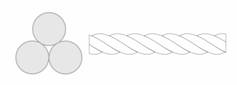
Twisted rope
3/4-strand
One of the oldest, simplest and most widely used rope constructions. Three or four strands are combined by twisting.


Twisted rope
One of the oldest, simplest and most widely used rope constructions. Three or four strands are combined by twisting.
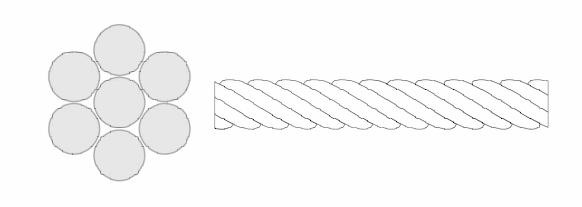
Twisted rope
In a 6-strand construction, six strands are tightly twisted around a central strand. The 50–80 mm versions are used for large vessels and winches anchored to the ocean floor. Because of the high twist, no additional cover is needed to hold the strands together when tension is removed.
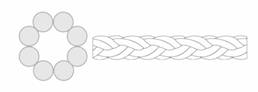
Plaited rope
The 8-strand plaited rope is produced using a plaiting technique. It is torque-balanced and does not tend to turn back and unwind when tension is removed.
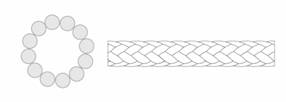
Hollow braided rope
Half of the carriers move clockwise and the other half counter-clockwise, alternating between inside and outside positions. The central hollow helps distinguish the construction, but the hollow in 8- and 12-strand braided ropes disappears under tension. Each strand moves individually while an 8-strand braid is formed. The 8-strand braided construction is popular for twine and ropes up to 8 mm in diameter; a 12-strand braided construction is preferred for rope diameters of 12–96 mm.
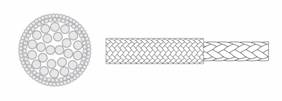
Double-braided rope
A braided cover is placed over a braided inner core. Rope tension is shared by the inner and outer parts.
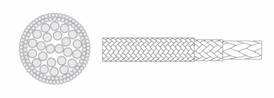
Double-braided rope
This is a subtype of double-braided rope. The inner core has a hollow-braid or 8-strand plaited construction. The core carries the principal load, while the braided cover protects the rope against external effects and abrasion. The core is made from high-strength, high-modulus material and the cover is generally polyester. A thick cover can be used to increase resistance to heavy friction and cuts.
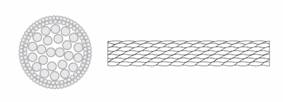
Solid braided rope
This solid braided rope is little used in industry. In this construction, conversion of fibre strength into rope strength is limited. Sharp crossing angles just under the surface cause relatively high mechanical elongation. It has the greatest springiness among these rope constructions. If one strand breaks, the rope may unravel. It may be selected for its round, attractive outer surface rather than its mechanical performance.
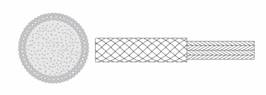
Kernmantle rope
A kernmantle rope consists of a core and a surrounding mantle. Different constructions can be used for the core and mantle. Possible core constructions include multiple S- and Z-twisted yarns, multiple small-diameter S- and Z-twisted ropes, or multiple long-pitch braided ropes.
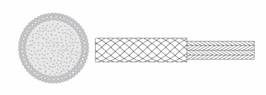
Parallel braided rope
In parallel-strand ropes, strands gathered at the centre may each be a small-diameter rope or a bundle of twisted yarns. This construction is suitable for producing very long ropes. Especially in marine uses, it can provide good fatigue life under cyclic loading. Where low-twist or low-braid-angle small ropes form the centre, fibre strength can contribute substantially to rope strength, especially at large diameters.
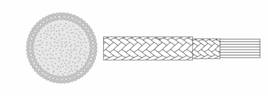
Parallel yarn rope
Parallel-yarn ropes use a zero-twist construction. They consist of many parallel textile yarns inside a plastic cover.